
Kim’s Post-Weight Loss Transformation: From 50kg Loss to 5 Pants Sizes Smaller
Kim’s journey matters because it’s real. He funded his surgery through superannuation (proof of medical necessity). He experienced minor complications during recovery (a wound infection, now resolved). And when his Sydney-based doctor saw the final results, he said something Kim will never forget: “I’ve never seen such fine work.”
This isn’t a marketing story. It’s a medical story. And if you’ve lost significant weight and are living with excess skin, it might be your story too.
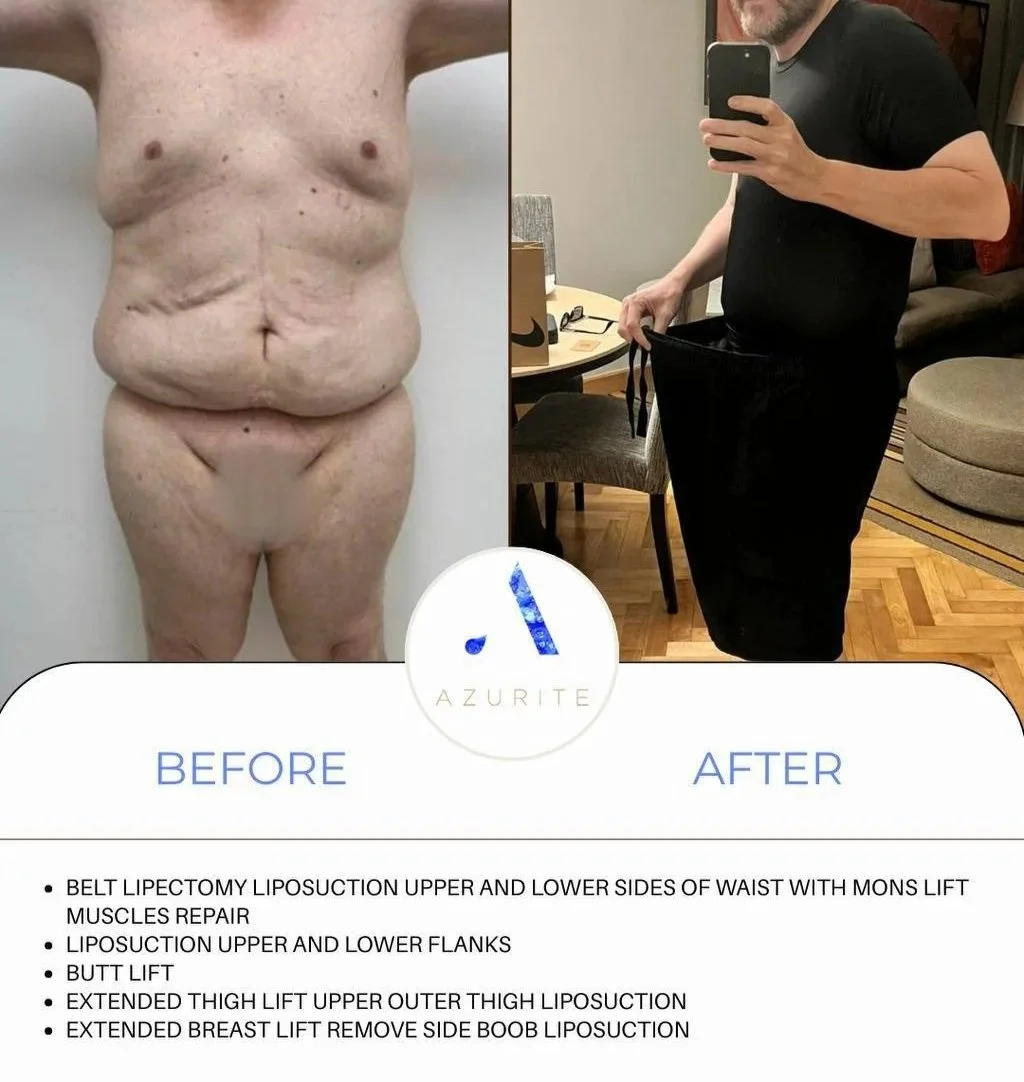
The Reality After Massive Weight Loss: Excess Skin
When you lose 50, 70, 100+ kilograms, your body performs an extraordinary feat. Fat cells shrink. Organs decompress. Blood pressure normalises. Diabetes often resolves. You’ve reversed years of metabolic damage through sheer will and discipline.
But here’s what doesn’t reverse: skin.
Skin is an organ, and like any organ, it has limits. When stretched beyond its elastic capacity for years or decades, the collagen and elastin fibres that give skin its “snap-back” quality break down. When the fat disappears, the skin that once held it in place remains: deflated, redundant, hanging.
The amount of excess skin depends on several factors: how much weight you lost, how quickly you lost it, your age, your genetics, and whether you smoked (smoking damages collagen). But for most people who’ve lost 25+ kilograms, excess skin is inevitable. And it’s not just an aesthetic problem.
Functional problems caused by excess skin:
Skin fold chafing causes painful rashes, blisters, and raw skin
Fungal and bacterial infections thrive in moisture trapped in folds
Hygiene becomes difficult when you can’t keep skin folds clean and dry
Excess skin on thighs or abdomen restricts movement during exercise
Clothing never fits properly (too small for the skin, too large for the frame underneath)
The psychological toll: after losing all that weight, you still feel uncomfortable in your own body
And here’s the hardest truth: exercise and diet can’t fix this. You can build muscle underneath. You can burn the last bits of stubborn fat. But you cannot shrink skin. Once the elastic limit is exceeded, only surgical removal can address it.
This isn’t a failure of effort. It’s a biological reality. And for many people, recognising that body contouring after massive weight loss is medically necessary (not cosmetic vanity) is the first step towards completing their transformation.
Kim’s Starting Point: Life After Weight Loss
Kim had done the work. He’d lost over 50 kilograms and kept it off. His health markers were transformed. But his body told a different story.
He was left with significant excess skin across his abdomen, chest, thighs, arms, and flanks. The skin on his midsection hung in folds. His chest had deflated, leaving loose tissue. His thighs rubbed together when he walked. His arms had hanging skin that made wearing short sleeves uncomfortable.
Functionally, the excess skin created problems. He developed rashes in skin folds. Exercise was difficult: the excess skin moved independently from his body during activity, which was uncomfortable and limiting. Clothes never fit right. He’d gone from obesity to a “normal” BMI, but he still felt trapped in a body that didn’t reflect his achievement.
Psychologically, it was exhausting. He’d worked so hard to lose the weight, but the reward felt incomplete. Every time he looked in the mirror, he saw the past instead of the present. Friends and family celebrated his weight loss, but he still felt self-conscious about his body.
After researching his options, Kim learnt that body contouring following massive weight loss often qualifies as medically necessary surgery. The functional impairments (skin infections, mobility limitations, hygiene issues) are recognised medical problems, not purely aesthetic concerns.
He consulted with Azurite to discuss surgery with Dr Theerapong, their ISAPS-accredited surgeon based in Bangkok who specialises in body contouring for patients who’ve had significant weight loss. Dr Theerapong assessed Kim’s case through photos and consultation and confirmed: this was medically necessary work.
Together with Azurite’s team, they explored the superannuation funding pathway. Dr Rob, who assists Azurite patients with superannuation applications, helped Kim navigate the documentation required to access his retirement savings early for this medically justified surgery.
That consultation was the turning point. Kim wasn’t pursuing vanity. He was pursuing completion.
The Procedures: Comprehensive Body Contouring
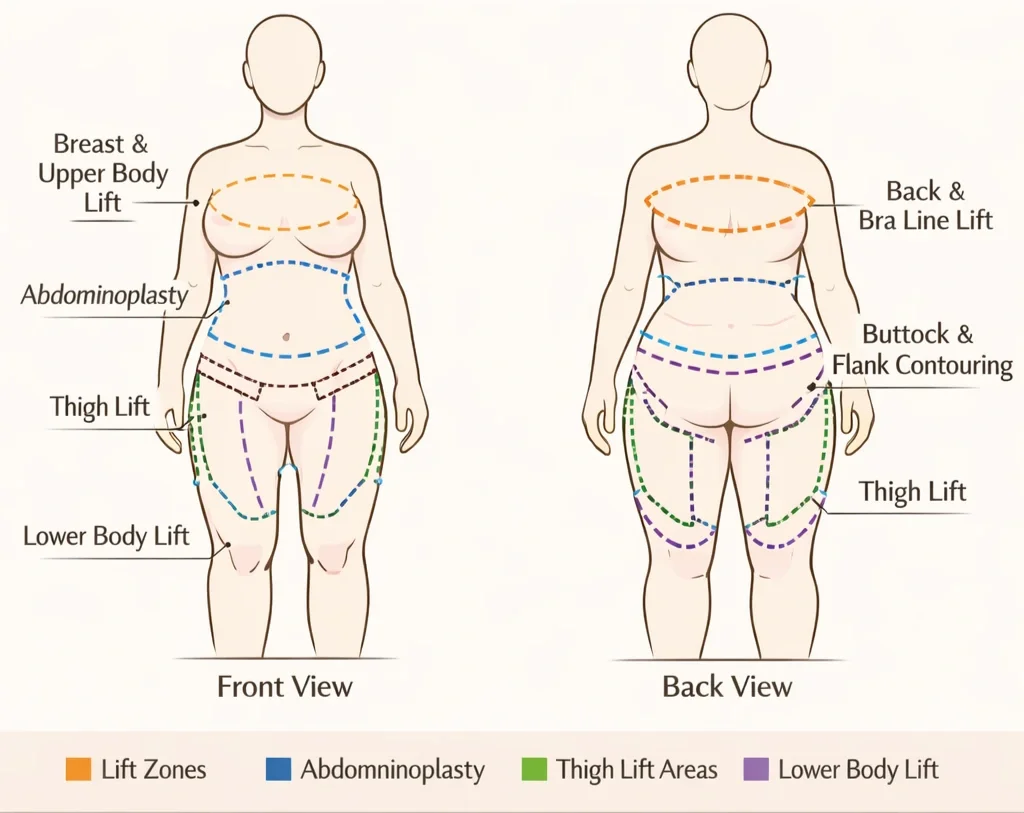
Body contouring after massive weight loss isn’t one procedure. It’s a comprehensive surgical plan that addresses excess skin across multiple body areas simultaneously. Kim’s case involved five interconnected procedures:
1. Belt Lipectomy (360° Lower Body Lift)
This is the cornerstone procedure for patients who’ve lost significant weight. A belt lipectomy removes excess skin and fat circumferentially around the entire waistline: front, sides, and back in one continuous surgical approach.
For Kim, this addressed: - The abdominal pannus (hanging skin on lower abdomen) - Separation of abdominal muscles (commonly called diastasis recti), which were repaired (similar to an abdominoplasty but more comprehensive) - Excess skin on the flanks (love handles) - Sagging skin on the lower back - Mons pubis lift (pubic area elevation)
The result: a defined waistline and flat abdomen for the first time in years.
2. Flank Liposuction (Upper and Lower)
Even after weight loss, some stubborn fat deposits remain. Kim had residual fat on his upper and lower flanks that created visual bulk. Liposuction sculpted these areas and created smooth transitions between the treated zones.
3. Butt Lift
Weight loss often causes significant volume loss in the buttocks, leaving sagging skin. A butt lift removes excess skin and repositions the remaining tissue to create a lifted, more youthful contour. For Kim, this improved his overall lower body proportion.
4. Extended Thigh Lift + Outer Thigh Liposuction
Excess thigh skin was one of Kim’s major functional complaints. It caused chafing and limited his ability to exercise comfortably. An extended thigh lift removes skin from the inner and outer thighs and repositions the remaining tissue.
Liposuction of the outer thighs refined the contour and created a smoother transition from hip to knee.
5. Extended Breast Lift + Side Liposuction
In men who’ve lost significant weight, the chest often develops excess skin and residual glandular tissue. For Kim, this created a deflated, sagging appearance.
The extended breast lift (male breast reduction) removed excess chest skin and tissue, creating a flatter, more masculine chest contour. Liposuction of the lateral chest (side) further refined the result.
Why Multiple Procedures Together?
Some surgeons stage body contouring into multiple separate surgeries, spaced months apart. Others, like Dr Theerapong, perform comprehensive procedures in one surgery when it’s safe to do so.
Advantages of the comprehensive approach: - One anaesthesia session (reduced cumulative anaesthesia risk) - One recovery period (back to life in weeks instead of months) - Better aesthetic balance (surgeon sees the whole body, creates proportional results) - Cost efficiency (one hospital stay, one surgical fee structure)
Safety considerations: - Surgical time must be reasonable (typically under 8 hours) - Blood loss monitored carefully - Patient must be healthy enough for extended anaesthesia - Post-operative monitoring is critical
Kim’s case was managed safely. Dr Theerapong’s experience with high-volume body contouring work allowed him to execute this comprehensive plan effectively.
Choosing the Right Surgeon: Why Expertise Matters
Not all plastic surgeons are qualified to perform body contouring after massive weight loss. This is highly specialised work that requires specific training and experience.
What makes a surgeon qualified for these cases:
Specialisation in body contouring after massive weight loss (this isn’t general cosmetic surgery; it requires understanding the unique challenges of excess skin)
High annual volume (surgeons who perform 50+ procedures per year develop refined techniques and better complication management)
Board certification or accreditation (look for ISAPS (International Society of Aesthetic Plastic Surgeons) membership or equivalent credentialing)
Hospital privileges (major body contouring should be performed in JCI-accredited hospitals, not office-based facilities)
Extensive before and after portfolio (ask to see results from patients with similar body types and weight loss)
Dr Theerapong’s credentials:
Dr Theerapong is Azurite’s lead plastic surgeon, based in Bangkok. He is an ISAPS-accredited surgeon who specialises in body contouring for patients who’ve had significant weight loss. He performs over 200 body contouring procedures annually, making him one of the highest-volume cosmetic surgeons in the region.
His patients receive comprehensive surgical care in JCI-certified hospitals with 24/7 nursing support during recovery in Bangkok. After returning to Australia, patients have ongoing WhatsApp access to Azurite’s Thai nursing team for questions and support.
For Kim, choosing a surgeon with this level of specialisation was critical. Tissue after massive weight loss is more challenging to work with than standard body contouring tissue. Blood supply can be compromised. Wound healing is more unpredictable. Scarring requires careful management.
A surgeon who performs five of these cases per year is still learning. A surgeon who performs 50+ per year has seen every variation, every complication, and developed strategies to optimise outcomes. Volume breeds expertise.
Red flags to avoid when choosing a surgeon: - Surgeon has no specific portfolio for weight loss patients - No hospital privileges (office-only surgery for major cases) - Promises “no scars” or “perfect results” (unrealistic) - Can’t clearly explain their complication rate - Unclear or unverifiable credentials
Your surgeon should be someone you trust with your life, because that’s literally what you’re doing when you go under general anaesthesia for 6-8 hours.
Funding Through Superannuation: How It Works
One of the biggest barriers to body contouring after weight loss is cost. Comprehensive packages can range from $30,000 to $60,000+ AUD. Private health insurance rarely covers it (classified as cosmetic in most cases). Medicare doesn’t cover it.
But there’s a pathway many Australians don’t know about: early access to superannuation for medically necessary surgery.
What qualifies as “medically necessary”:
The Australian Taxation Office (ATO) allows early superannuation access for medical treatment if: - The condition causes significant functional impairment - The treatment is not available through the public health system - The treatment is supported by medical documentation
Body contouring after massive weight loss often qualifies because the excess skin causes: - Chronic skin infections (documented by GP) - Mobility limitations (impacts daily function) - Hygiene issues (medical problem, not aesthetic) - Psychological distress (supported by mental health professional)
How to apply for early super access:
GP referral and documentation:
Visit your GP and document functional problems
Photos of affected areas
Medical history of skin infections, rashes, or other issues
GP letter supporting medical necessity of surgery
Specialist (plastic surgeon) assessment:
Consultation with a qualified plastic surgeon (Dr Theerapong reviews cases via photos and video consultation)
Clinical assessment confirming excess skin is causing functional impairment
Detailed treatment plan outlining required procedures
Surgeon’s letter supporting superannuation application
Superannuation application support:
Dr Rob (who assists Azurite patients with super applications) can help prepare documentation
Application form (varies by fund)
GP letter
Surgeon’s letter
Photos (clinical documentation)
Treatment cost estimate
Fund assessment:
Superannuation fund reviews medical documentation
May request additional information
Assessment timeline: 4-8 weeks typically
If approved, funds released:
Money released directly to you
You pay for surgery using released funds
Kim’s experience:
Kim applied for superannuation access with support from his GP, Dr Theerapong’s clinical assessment, and documentation assistance from Dr Rob. His application highlighted: - Documented skin infections in abdominal folds - Mobility limitations during exercise - Psychological distress from body image mismatch after weight loss - Functional impairment in daily activities
His fund approved the application. The released funds covered his Expert Skin Removal Package (approximately $32,000 AUD at current exchange rates).
Important disclaimers: - Not everyone qualifies (assessed case-by-case) - Purely cosmetic procedures don’t qualify - Cases involving significant weight loss have stronger medical justification due to functional impairment - Consult your accountant or financial adviser about tax implications - Approval is not guaranteed
For more detailed guidance on superannuation for medically necessary surgery, see our comprehensive resource page.
The Cost: What $35,000 USD (~$54,250 AUD) Covers
Kim’s surgery was performed under Azurite’s Expert Skin Removal Package, designed specifically for patients requiring comprehensive body contouring after significant weight loss.
What the package includes: - All five surgical procedures (belt lipectomy, liposuction, lifts) - General anaesthesia - JCI-certified hospital stay (3 nights post-operative monitoring) - Surgeon fees (Dr Theerapong) - All post-operative compression garments - 6 nights recovery accommodation in Bangkok - All meals during recovery (tailored to post-operative nutrition) - 24/7 nursing care during Bangkok stay - Wound care supplies - Prescribed medications (pain relief, antibiotics, anti-inflammatories) - Airport transfers (pickup and drop-off) - WhatsApp follow-up support with Thai nursing team after returning to Australia
Why comprehensive packages are cost-effective:
If Kim had pursued these procedures separately over time, the costs would have been: - Belt lipectomy alone: $13,100 USD - Thigh lift: $8,600 USD - Breast lift: $8,000 USD - Butt lift: $7,600 USD - Liposuction (flanks): Approx $5,000 USD
Piecemeal total: $42,300 USD+
That’s seven thousand dollars more, plus: - Multiple hospital stays - Multiple anaesthesia sessions (cumulative risk) - Multiple recovery periods (6-12 months total downtime) - Inconsistent aesthetic results (procedures done at different times don’t always blend well)
The comprehensive approach costs less and produces better, more balanced results. It’s the gold standard for body contouring after massive weight loss.
For alternative financing options if superannuation isn’t available, see our payment plans page.
The Surgery & Recovery Journey
Pre-operative preparation:
Kim underwent standard pre-surgical testing: bloodwork, ECG, and chest X-ray. He stopped smoking six weeks before surgery (critical for wound healing). He optimised his nutrition, focusing on high-protein intake to support tissue repair.
Mentally, he prepared by understanding the recovery timeline. Body contouring after massive weight loss is major surgery. The recovery is not easy. But it’s finite, and the alternative (living with excess skin indefinitely) felt worse.
Travel to Bangkok:
Kim flew to Bangkok and was met at the airport by Azurite’s transfer service. He settled into his accommodation and had a final pre-operative consultation with Dr Theerapong to review the surgical plan.
Because Kim’s case was extensive (five procedures across multiple body areas), Dr Theerapong recommended a staged approach: two surgery sessions spaced one week apart. This reduces anaesthesia time, allows the body to recover between sessions, and minimises surgical risk. Not every surgeon has the expertise to stage complex cases safely. This is a hallmark of Dr Theerapong’s experience.
Surgery Day 1 (31 December 2025):
Kim’s first surgery session addressed his lower body: belt lipectomy (360° lower body lift), flank liposuction, butt lift, and extended thigh lift. The surgery took approximately 6 hours under general anaesthesia in a JCI-certified hospital. Surgical drains were placed to remove excess fluid during healing. Compression garments were applied immediately after surgery to minimise swelling and support healing tissues.
Hospital stay (1-2 nights):
Kim spent one night in hospital for close monitoring. Pain was managed with IV medication initially, then transitioned to oral pain relievers. He was encouraged to walk short distances to prevent blood clots. Drain output was monitored.
Recovery accommodation (Days 2-7):
After hospital discharge, Kim moved to Azurite’s recovery accommodation where he had 24/7 nursing support. The nursing team managed wound care, medication schedules, drain monitoring, and answered questions. This is the critical healing window when complications are most likely, so having professional care on-site provides significant peace of mind.
The first few days were the hardest. Pain was significant but manageable with medication. Swelling was extensive. Bruising covered most of the treated areas. Kim’s mobility was limited: no bending at the waist, no lifting, no twisting. Surgical drains remained in place and were monitored daily. Compression garments were worn 24/7.
Surgery Day 2 (7 January 2026):
One week after the first surgery, Kim returned to hospital for his second session: extended breast lift and lateral chest liposuction. Because the lower body was already healing, Dr Theerapong could focus exclusively on the chest area. This surgery took approximately 2 hours.
The staged approach meant Kim’s body wasn’t overwhelmed by one massive surgical trauma. Recovery from the second surgery was faster because it was less extensive.
Hospital stay (1 night):
Kim spent one night in hospital again for monitoring. Pain from the second surgery was less intense than the first (smaller surgical area). He was already mobile from the first recovery week, which helped.
Days 8-21 (Extended recovery in Bangkok):
Kim spent the remainder of his 21-day package in recovery accommodation with 24/7 nursing support. This extended stay was crucial for several reasons:
Drains from both surgeries were progressively removed (typically 7-10 days post-surgery)
Wound care was managed professionally during the highest-risk infection window
Any complications could be addressed immediately by the nursing team and Dr Theerapong
Kim didn’t have to manage complex wound care alone at home
During this period, Kim developed a minor wound infection in one of the incision sites. This isn’t uncommon in extensive body contouring cases, especially given the surface area of incisions. The nursing team identified it early, consulted with Dr Theerapong, and prescribed antibiotics. The infection resolved without affecting the final outcome.
This is an important detail. Surgery is not without risk. Complications happen even with excellent surgical technique. What matters is how they’re managed. Kim’s infection was caught early because he had 24/7 nursing care in Bangkok, treated appropriately, and didn’t compromise his results. If he’d flown home after 7-10 days (as some clinics allow), managing this alone in Sydney would have been far more stressful.
The value of 21 days:
Many clinics offer 10-14 day packages to keep costs down. Kim’s 21-day package cost more, but the extended professional support meant: - Both surgeries staged safely with recovery time between - All drains removed before flying home - Infection caught and treated in Bangkok (not managed via WhatsApp from Australia) - No rushed travel while still swollen and vulnerable - Complete wound healing before long-haul flight
By Day 21, Kim was mobile, drains were out, wounds were healing well, swelling had reduced significantly, and he was cleared for travel.
Return to Australia (Day 21):
Kim flew home stable and healing well. He wore compression garments during the flight and was given detailed care instructions for the next 4-6 weeks.
Post-Australia follow-up:
After returning home, Kim had WhatsApp access to Azurite’s Thai nursing team. He could send photos of his incisions, ask questions about pain levels, swelling, or activity restrictions, and receive guidance. This ongoing support continued for the first 6-8 weeks following surgery.
For wound checks, Kim visited his local GP in Sydney. At one of these appointments, the GP examined Kim’s scars and said something Kim will never forget: “I’ve never seen such fine work.” This wasn’t a surgeon affiliated with Azurite. This was an independent Australian doctor amazed by the surgical quality.
Weeks 4-8 (Gradual return):
Pain decreased significantly. Swelling continued to reduce (though still visible). Light activity was allowed: walking, light office work. Driving was cleared around Week 4-5. Compression garments remained in place for 8-12 weeks total.
Months 2-6 (Final results emerging):
Swelling fully resolved by Month 3-4. Scars began fading from pink to white. Kim received clearance for full exercise by Month 4. His body settled into its new shape.
The transformation became clear: he was finally living in a body that matched his effort.
Key Takeaways from Kim’s Journey
Why staging matters: Performing all five procedures in one 7-8 hour surgery is possible, but staging into two sessions (as Dr Theerapong did) reduces anaesthesia risk, allows targeted focus on each body area, and gives the body time to recover between surgeries. Not all surgeons have the volume or expertise to stage safely. This requires precise surgical planning.
Why 21 days matters: Extended recovery in Bangkok meant Kim had professional support during the entire critical healing window. His wound infection was caught and treated on-site. He didn’t fly home with drains still in. He wasn’t managing complex wound care alone. The extra week in Bangkok likely saved him weeks of stress at home.
Why honesty matters: Kim had a complication (infection). But it was managed well, and his results are exceptional. This is reality. Surgery carries risk. What distinguishes good surgeons from great ones is complication management, not complication avoidance (which is impossible to guarantee).
Kim’s journey wasn’t flawless, but it was safe, well-managed, and ultimately transformative.
The Results: 5 Pants Sizes & Exceptional Healing
Functional outcomes:
Kim now wears size 36 pants. Before surgery, he was wearing size 41. That’s five full pants sizes: a transformation that goes far beyond aesthetics.
Clothes fit properly for the first time in years. He can exercise without excess skin limiting his range of motion or causing chafing. Hygiene is simpler. He feels comfortable in his own skin.
Aesthetic outcomes:
Kim has a defined waistline. His body contour is proportional from shoulders to thighs. The transitions between treated areas are smooth and natural-looking. There are no visible “steps” where one procedure ended and another began; the hallmark of skilled surgical planning.
Third-party validation:
At a follow-up wound check with his Sydney-based GP (not affiliated with Azurite), Kim received feedback that meant everything:
“The doctor was amazed at just how good the scar was. He told me he had never seen such fine work and everything is perfect.”
This quote is significant. Kim’s GP sees post-surgical patients regularly. For him to say “never seen such fine work” speaks to Dr Theerapong’s surgical precision. Scar quality is one of the most important markers of surgical excellence in body contouring.
Good scars are: - Placed in natural body creases where possible - Closed with appropriate tension (not too tight, not too loose) - Managed post-operatively to minimise excessive scarring - Thin, flat, and fade over time
Kim’s scars met all these criteria. That’s not luck. It’s technical skill.
Psychological outcomes:
Kim’s confidence is restored. He feels comfortable in fitted clothing. He can wear a T-shirt without self-consciousness. His body finally reflects the hard work he put into losing the weight.
This is the ROI that no financial calculation can capture: the feeling of finally being at home in your own body.
What Makes This an Exceptional Outcome?
Not all body contouring results after weight loss are created equal. So what made Kim’s outcome exceptional?
Scar quality:
As mentioned, Kim’s GP was amazed by the scar quality. Factors that contribute to good scarring include: - Surgical technique (proper tension management, meticulous closure, appropriate suture choice) - Tissue viability (adequate blood supply to wound edges; surgeon must plan incisions to preserve vascular supply) - Patient factors (non-smoking, good nutrition, following post-operative instructions) - Genetic factors (some people scar better than others; uncontrollable)
Dr Theerapong’s technique delivered results that impressed an independent medical professional.
Aesthetic balance:
Kim had five different procedures across his entire torso and limbs. Achieving proportional, balanced results across that many areas requires surgical planning and experience. There are no over-corrected zones (too tight) or under-corrected zones (residual laxity). Everything flows.
Minimal complications:
Kim had one minor wound infection, managed appropriately with antibiotics. Otherwise, his recovery was uncomplicated. No haematoma (blood collection), no seroma (fluid collection), no skin necrosis (tissue death), no wound dehiscence (incision opening).
Given the extent of surgery, this is an excellent outcome.
Why volume and expertise matter:
Surgeons who specialise in body contouring after weight loss and perform 50+ cases annually (like Dr Theerapong, who performs 200+ annually) develop: - Refined technique from repetition - Pattern recognition (identifying what works, what doesn’t) - Faster operative times (reduces anaesthesia risk) - Better complication management (they’ve seen it all) - More predictable outcomes
Dr Theerapong’s specialisation in this work is why Kim’s results were exceptional, not just good.
Is Body Contouring After Weight Loss Right for You?
Kim’s story is inspiring. But it’s one person’s experience. Is this surgery right for you?
You may be a candidate if:
You’ve lost 25+ kilograms and maintained stable weight for 6-12+ months
You have significant excess skin causing functional problems (chafing, infections, mobility issues)
You’re a non-smoker (or willing to quit 6 weeks before surgery)
You have realistic expectations (scars are inevitable; results aren’t “perfect”)
You’re in good overall health and cleared for general anaesthesia
You’re mentally prepared for a challenging recovery
You’re willing to travel to Bangkok for surgery and recovery
You may NOT be a candidate if:
You’re still actively losing weight (wait until stable)
You smoke (significantly increases complication risk)
You have unrealistic expectations (“no scars”, “perfect body”)
You have uncontrolled health conditions (diabetes, heart disease)
You’re not willing to commit to recovery protocol
You cannot travel internationally
Questions to ask your surgeon:
How many body contouring cases after weight loss do you perform annually?
Can I see before and after photos of patients with body types similar to mine?
What are the most common complications in these cases, and how do you manage them?
Will my procedures be staged (multiple surgeries) or done together? Why?
What’s the realistic recovery timeline for my specific case?
What credentials and accreditations do you hold?
Where will surgery be performed? (JCI-accredited hospital?)
What support is available after I return to Australia?
When to wait:
If your weight isn’t stable yet (wait 6-12 months after reaching goal weight)
If you’re planning pregnancy (wait until after)
If your mental health isn’t stable (address this first with professional support)
For more information, visit our frequently asked questions page.
Your Next Step: Free Consultation
If Kim’s story resonates with you, the next step is a consultation. Not a sales pitch. An honest assessment of whether body contouring after weight loss is right for your situation.
How Azurite consultations work:
Fill out a brief online form (5-10 minutes)
Your weight loss journey (how much, how long stable)
Current concerns (functional, aesthetic, psychological)
Medical history
Photos (optional but helpful for assessment)
Superannuation interest
Australian team review with Dr Theerapong assessment
Our Australian team coordinates with Dr Theerapong
He reviews your case via photos and video consultation
We determine candidacy
We discuss superannuation pathway if applicable (with Dr Rob’s assistance)
Personalised treatment plan
Specific procedures recommended for your case
Cost estimate (package pricing)
Recovery timeline in Bangkok and at home
Superannuation guidance if relevant
No pressure
A consultation is information, not a commitment
Take time to decide
Second opinions are encouraged
Why Azurite for body contouring after weight loss:
Dr Theerapong’s specialisation in complex body contouring (200+ procedures annually)
JCI-certified hospitals in Bangkok
24/7 nursing support during critical recovery window
Experience guiding Australian patients through superannuation pathway
Comprehensive packages (multiple procedures, one recovery, one price)
WhatsApp follow-up support after returning to Australia
Extensive before and after gallery showcasing real patient results
Ready to explore your options?
Book a free consultation to discuss your body contouring goals after weight loss. No obligation. Just information from people who understand what you’ve been through.
Medical Disclaimer: This article describes one patient’s experience and is for informational purposes only. Individual results vary significantly and cannot be guaranteed. Body contouring after weight loss carries risks including infection, bleeding, scarring, poor wound healing, seroma, haematoma, skin necrosis, asymmetry, nerve damage, blood clots, anaesthesia complications, and unsatisfactory aesthetic results. Surgery is not suitable for everyone. Superannuation access for medical procedures is assessed case-by-case by individual funds and approval is not guaranteed. Always consult a qualified, accredited plastic surgeon and your GP to determine if you are a candidate. This content does not constitute medical advice and should not replace professional consultation. Travel for surgery carries additional risks including extended recovery away from home support systems.
