
Mummy Makeover Thailand: Costs, Packages & What to Expect
If you're researching a mummy makeover Thailand trip, you've probably already waded through price lists and package grids. What's harder to find is a clear, honest breakdown of what the whole process actually involves, medically, logistically, and financially, before you book anything. That's what this guide covers.
This information is general in nature and is not medical advice. Every person's suitability for treatment is different. A consultation with a qualified practitioner is required before any procedure.
All procedures carry risks. The potential benefits, risks, and alternatives should be discussed with your treating practitioner before any decision is made.
What is a mummy makeover?
A mummy makeover describes a combination of surgical procedures aimed at addressing physical changes that commonly follow pregnancy, childbirth, and breastfeeding. It's not a single standardised operation. The specific combination is tailored to each patient based on their anatomy, health history, and goals.

According to Bumrungrad International Hospital's health blog, typical combinations include breast augmentation, breast lift (mastopexy), abdominoplasty (tummy tuck), and liposuction to the flanks, hips, or thighs. Some patients also add procedures such as labiaplasty or arm lift, depending on their individual concerns.
Candidates are generally women who've completed their families and are in good overall health. Body weight should be stable before surgery, because significant fluctuations afterwards can affect results. Surgery can improve contour and address structural changes like diastasis recti (abdominal muscle separation) or significant skin laxity, but it won't produce a completely different body. A thorough medical assessment with a qualified practitioner is required to confirm whether you're a suitable candidate and which procedures are right for you.
What does a mummy makeover in Thailand cost in AUD?
Cost is one of the main reasons Australians consider travelling to Thailand for this type of surgery. The price difference can be considerable, though it shifts widely depending on which procedures you include, the hospital or clinic you choose, and the experience level of the surgical team.
For a general sense of the range, established Australian medical tourism operators list mummy makeover Thailand cost packages typically starting from around AUD $10,000 to $12,000 for a two-procedure combination. More comprehensive packages involving three or four procedures run from approximately AUD $15,000 to $25,000 or more. These figures cover surgery and hospital fees but may or may not include flights, accommodation, or post-operative garments.
By comparison, equivalent procedures in Australia cost considerably more. A tummy tuck alone commonly ranges from AUD $10,000 to $18,000, and breast augmentation from AUD $8,000 to $15,000, before you combine them. For a full breakdown of how Thailand and Australia compare on cosmetic surgery costs, it's worth reviewing the factors that drive those differences.
Several variables affect what you'll pay in Thailand:
The number and complexity of procedures included
Whether surgery takes place in a JCI-accredited hospital or a smaller private clinic
The surgeon's training background and years of experience
The level of post-operative care and follow-up included in the quote
Whether you're travelling independently or through a coordinator who has vetted the provider
Factor in costs that aren't always listed upfront: flights, accommodation for the recovery period (typically two to three weeks minimum), travel insurance that covers medical complications, and any follow-up care you'll need once you're back in Australia. The total trip cost is usually higher than the surgery quote alone.
What's usually included in a Thailand mummy makeover package?
Reputable providers structure their packages to cover the core surgical components, but what's actually included varies more than the marketing materials often suggest.
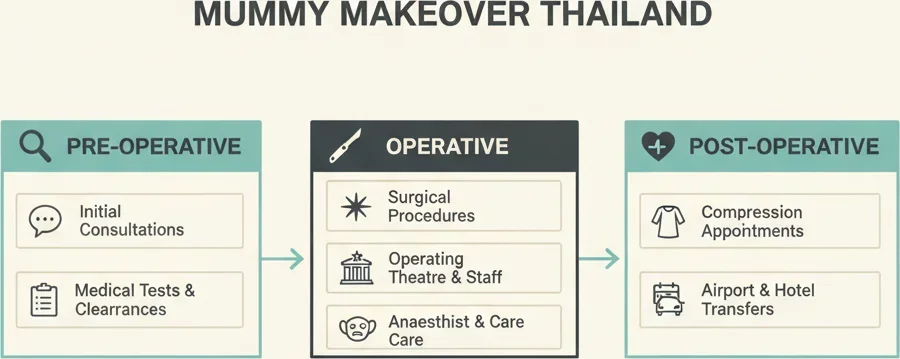
According to package details from Lotus Medical International, well-structured Thailand mummy makeover packages typically include:
Pre-operative consultations and blood tests
Surgeon and anaesthetist fees
Operating theatre and hospital room charges for the inpatient stay
Nursing care during the hospital admission
Post-operative compression garments
Airport and hospital transfers during the stay
Follow-up appointments before you fly home
What's often excluded or charged separately includes international flights, accommodation outside the hospital stay, travel insurance, additional nights if recovery runs longer than expected, and any revision procedures. Some packages also charge separately for implant costs, which can add AUD $1,000 to $3,000 or more to the total.
Before committing to any package, ask for a written itemised quote and confirm exactly what happens if you need to stay longer or require additional medical attention. A provider that's reluctant to answer those questions clearly is worth approaching with real caution.
Is Thailand a safe choice for mummy makeover surgery?
This is the question most Australians want a straight answer to. The honest answer is: it depends on where you go and how carefully you plan. Thailand has hospitals that meet internationally recognised standards, and it also has facilities that don't. That difference matters enormously when you're having major surgery.
For a thorough look at what you need to know about plastic surgery safety in Thailand, the key markers are hospital accreditation and surgeon credentials. Joint Commission International (JCI) accreditation is the most widely recognised international hospital quality standard. Hospitals such as Bumrungrad International, Bangkok Hospital, and Samitivej hold JCI accreditation, which involves rigorous assessment of clinical standards, infection control, and patient safety protocols.
Surgeon credentials require separate scrutiny. In Thailand, look for surgeons who are board-certified by the Royal College of Surgeons of Thailand and who have specific training in plastic and reconstructive surgery. Ask directly about the surgeon's qualifications, how many of these specific procedures they perform each year, and whether you can have a detailed consultation before committing.
A pre-travel medical assessment with your GP in Australia is strongly recommended before any overseas surgical trip. This should cover your general fitness for anaesthesia, any medications or conditions that could affect healing, and documentation of your health status that you can take with you. A consultation and medical assessment are required before any procedure is undertaken.
Flying long-haul shortly after major surgery carries real risk, particularly for deep vein thrombosis (DVT). Your surgical team should advise you on the minimum safe interval before flying, and you should build that window into your travel planning from the start.
How to choose the right clinic or coordinator in Thailand
Whether you're approaching a clinic directly or working through a coordinator, there are practical criteria that help you separate well-run providers from those cutting corners.
Start with accreditation. JCI-accredited hospitals have met documented international standards. If a provider can't tell you clearly which hospital will be used and whether it's accredited, that's a red flag.
Ask specifically about the surgeon. Their name, their qualifications, their registration with the Royal College of Surgeons of Thailand, and the number of procedures of this type they perform annually are all reasonable questions. A provider who deflects these or offers a generic "experienced surgeon" response isn't giving you enough to make an informed decision.
The consultation process matters too. Reputable providers offer a genuine pre-operative consultation, either in person once you arrive or via video call beforehand, where the surgeon reviews your medical history, examines you, and discusses what's realistic for your situation. Avoid providers who seem willing to confirm a procedure list and price without a proper assessment.
Aftercare is often underdiscussed. Find out what happens if you develop a complication after you return to Australia. Does the provider have a relationship with an Australian medical contact? Will they supply full surgical notes and records? Is there a clear process for reaching someone if you have concerns post-return? These aren't difficult questions, and any reputable provider should answer them without hesitation.
Red flags to watch for include pressure to book quickly, vague answers about surgeon credentials, packages that seem unusually cheap without a clear explanation of what's excluded, and no clear process for handling complications.
Recovery timeline: what to plan for
A mummy makeover involves multiple procedures under general anaesthesia, and recovery takes time. Planning this carefully before you travel is just as important as choosing the right provider.
The first two to three days post-surgery are typically spent in hospital. Most patients stay in Thailand for a minimum of two to three weeks before flying home, though your surgical team will give you specific guidance based on which procedures you've had. Flying before you're cleared to do so raises the risk of complications including DVT and wound breakdown.

A rough week-by-week picture looks like this:
Days one to five: hospital stay, close nursing supervision, managing initial swelling and discomfort
Days six to fourteen: recovery accommodation in Thailand, limited mobility, regular follow-up appointments, wound checks
Weeks three to six: gradual return to light activity after returning home, no heavy lifting or strenuous exercise
Weeks six to twelve: most patients return to normal daily activity, though full healing of deeper tissues takes longer
Three to twelve months: final results become clearer as swelling fully resolves
You'll need someone to help you at home for the first week or two after you return to Australia. Arrange this before you travel. Confirm with your employer how much time you'll need off work: desk-based roles typically require two to four weeks minimum, and physical roles considerably longer.
Risks, side effects, and setting realistic expectations
Every surgical procedure carries risk. A mummy makeover combines multiple procedures in one operation, so you need a clear-eyed understanding of what those risks are.
Common side effects across the procedures involved include pain and discomfort in the days and weeks following surgery, swelling and bruising that can persist for several weeks, temporary numbness or altered sensation around incision sites, and fatigue during the recovery period.
More serious risks include infection, haematoma (blood pooling under the skin), seroma (fluid accumulation), wound healing problems, scarring that's more pronounced than expected, asymmetry, changes in nipple sensation following breast procedures, and complications related to anaesthesia. Abdominoplasty carries a higher risk of DVT and pulmonary embolism compared to many other elective procedures, which is why flying restrictions post-surgery are taken seriously.
Implant-related risks for breast augmentation include capsular contracture, implant rupture, and the need for revision surgery over time.
Results vary between individuals. Photographs and case descriptions, including any mummy makeover Thailand before and after imagery you may see on clinic websites, are for illustrative purposes and are not a guarantee of outcome. Your result will depend on your anatomy, healing response, the specific procedures performed, and how well you follow post-operative instructions. Outcome language like "dramatic transformation" should be read with appropriate scepticism. Realistic improvement is a more honest frame.
A full medical assessment and consultation with a qualified practitioner are required before any decision is made.
Next steps: how Azurite can help you plan
Planning a mummy makeover Thailand trip involves a lot of moving parts, and getting the details right matters. At Azurite Medical & Wellness, we work with Australians to navigate the process from the beginning, helping you understand your options, ask the right questions, and connect with vetted providers in Thailand.
Book a free consultation to talk through your situation with our team, or talk to our team to get personalised guidance before you commit to anything.
